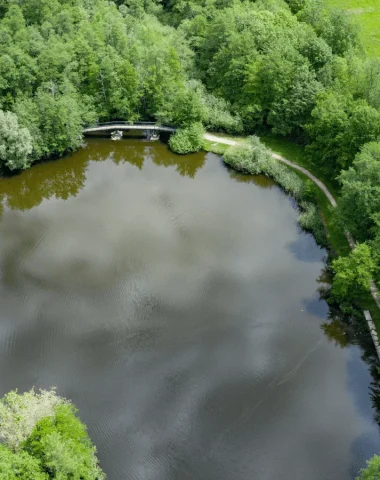


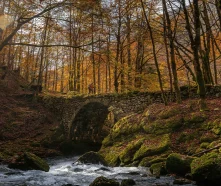

After heavy rain or when the snow melts, these large natural basins temporarily fill with water, creating stunning mountain lakes.
I’ll be talking mainly about my two favourite temporary lakes in the Valserine valley: Lac du Creux au Niaizet in Lélex and Lac de la Tremblaine in the hamlet of Les Sept Fontaines. They can be deep in the middle and much shallower around the edges.
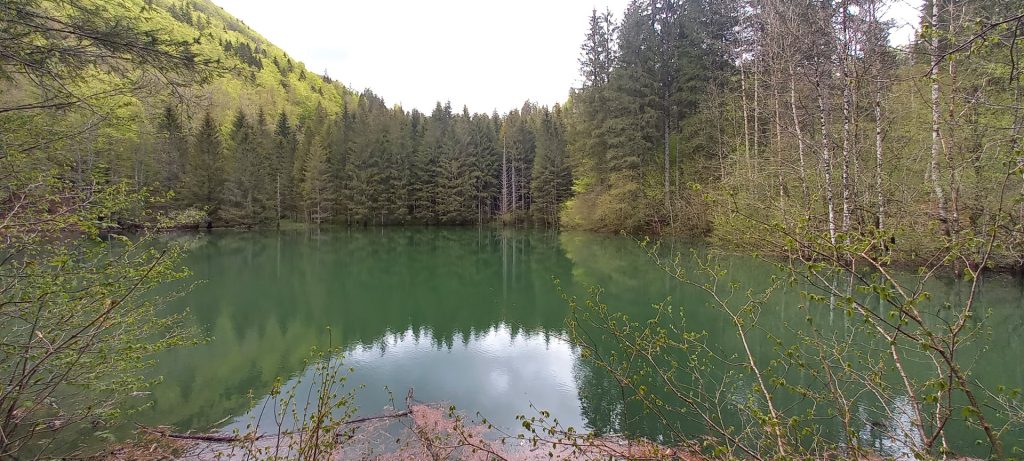
These temporary mountain lakes are found at altitudes of over 800m. Their crystal-clear water allows you to make out perfectly the diversity of nature at the bottom (dead leaves, stones, branches…).
What do these temporary lakes look like?
Their water is full of mineral particles that give them their green colour. Each particle corresponds to a particular colour. Slate particles give grey, iron particles give yellow and here the limestone particles give us this changing green from emerald to fir green.
But how do these lakes form?
In the Jura, the intermittent nature of these lakes is mainly due to the limestone karst. Over time, water seeps into the cracks in the limestone and carves out an entire underground network consisting of passages, caves, chasms and resurgences.
Certain natural depressions, such as valleys or sinkholes, have openings at the bottom through which water can enter this underground network. Under normal circumstances, rainwater seeps in and the basin remains dry or, at times, marshy.
However, following heavy rainfall or snowmelt, the volume of water arriving may exceed the underground network’s capacity to absorb it. The water then accumulates in the basin and a lake forms temporarily.
This phenomenon also depends on the nature of the basin’s floor. Certain sedimentary formations can, in fact, partially retain water. When this retention is incomplete and combined with underground seepage, the body of water becomes intermittent.
But why can’t I swim there in summer?
Spectacular as it may be, the lake is only temporary! When rainfall decreases and the groundwater level drops, the water that has accumulated in the basin gradually drains away through the karst system.
The lake eventually disappears, giving way to a meadow or a wetland. In other words, if you’d planned to bring a buoy, mask and snorkel for August, you’d be better off packing a good pair of shoes instead! You’ll actually be able to walk across a spot that, just a few weeks or months earlier, was still covered in water.
Lake du Creux in Lélex and Lake de la Tremblaine, in the hamlet of Les Sept Fontaines, are the two intermittent lakes in the upper Valserine valley.
Thematics